Academics
Academic Tracks and Programs
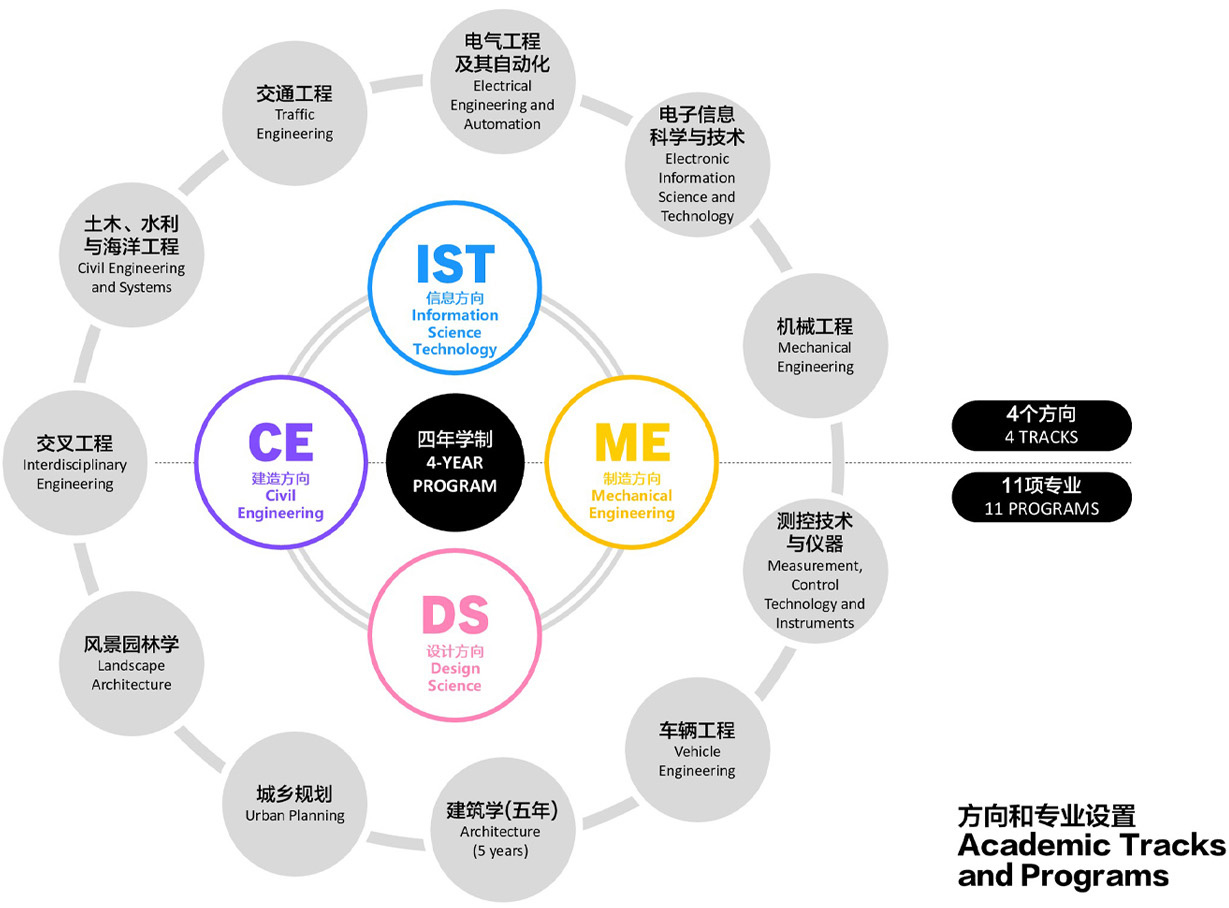
Students’ll be empowered to customise their learning based on the multi-disciplinary curriculum that integrates information science and technology (IST), mechanical engineering (ME), civil engineering (CE), and design science (DS) to develop their own knowledge system.
Curriculum
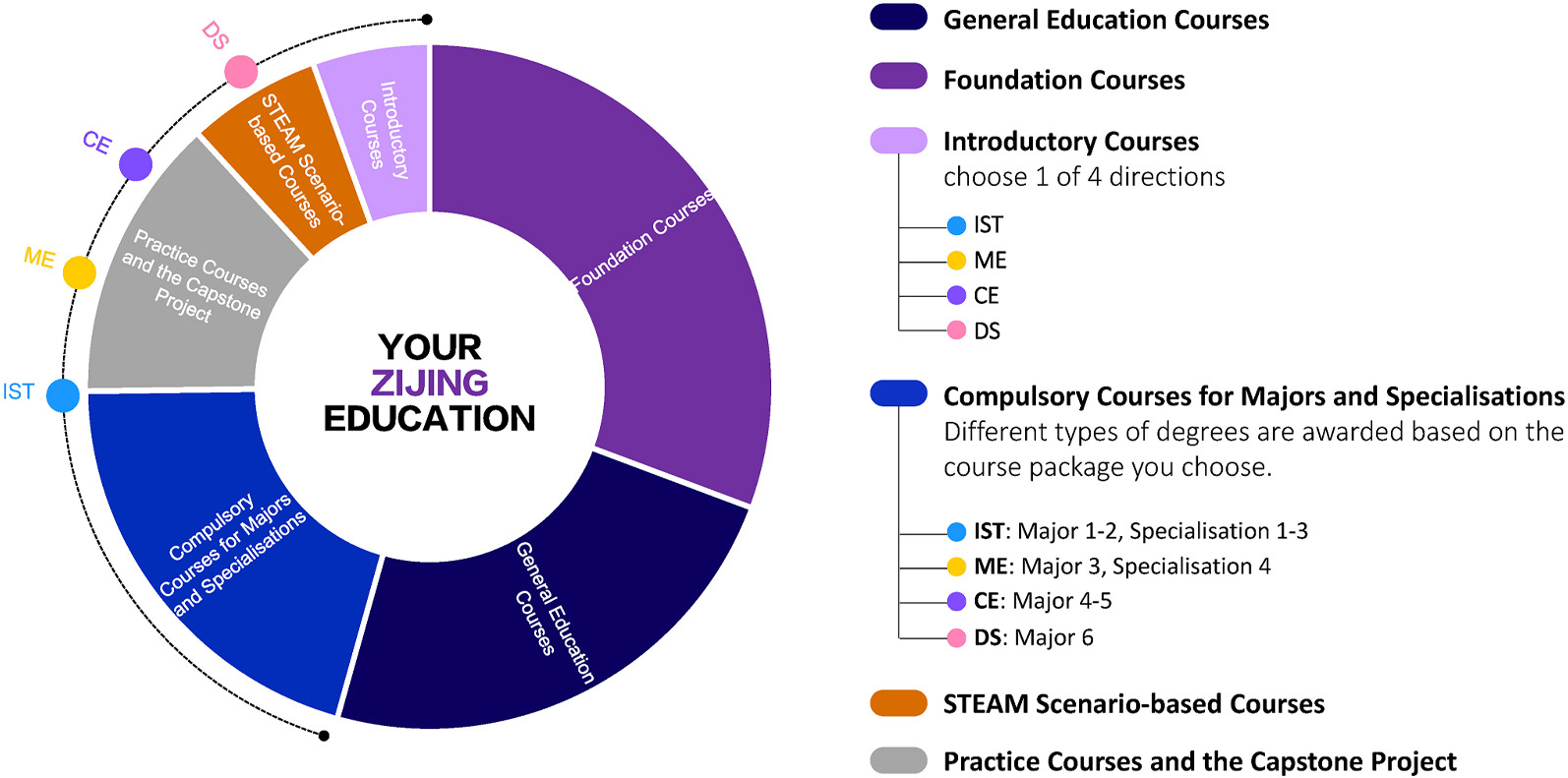
Students’ll be empowered to customise their learning based on the multi-disciplinary curriculum that integrates information science and technology (IST), mechanical engineering (ME), civil engineering (CE), and design science (DS) to develop their own knowledge system.
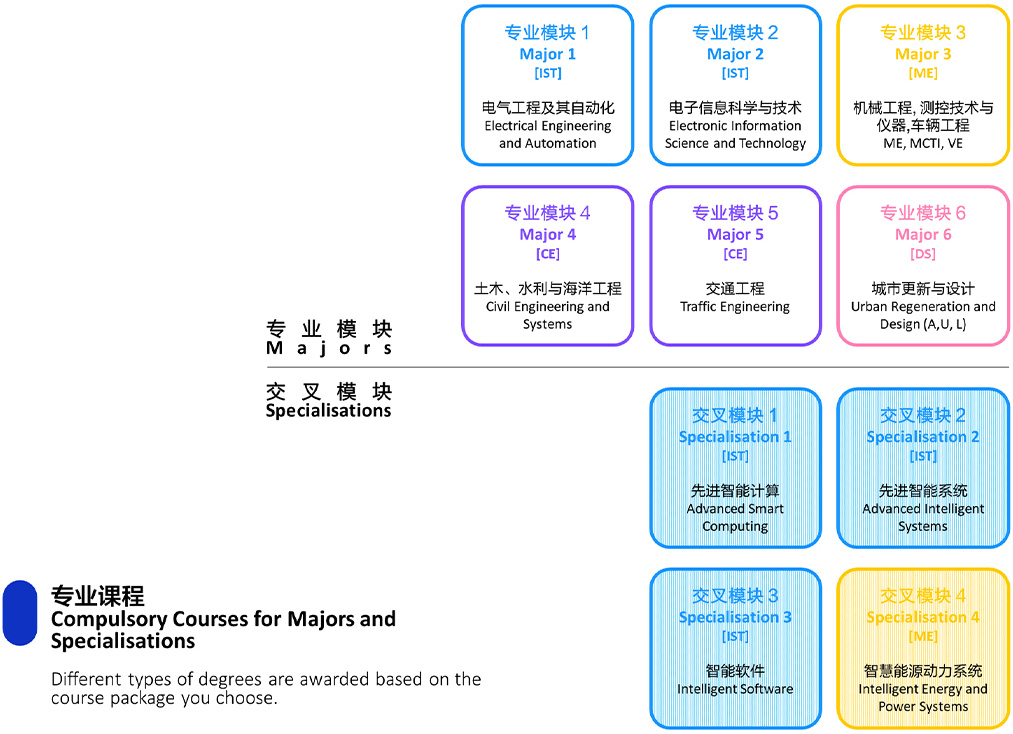
Majors and Specialisations
Students have the option of pursuing majors and specialisations from their chosen tracks by first taking introductory courses and subsequently a package of compulsory courses. Different types of degrees will be awarded.
- Specialisations:
- IST: Specialisation 1-3
- ME: Specialisation 4
STEAM Scenario-based Courses
Students are encouraged to select courses based on their interests and learning objectives. Scenario-based courses are taught using a blended method to promote interdisciplinary engagement.
- • Exploration and Practice in Electrical Engineering I - IV
- • Project Design and Making of Electronic System
- • Electronic System Design
- • Electromagnetic Field and Microwave Experiment
- • Basic Experiments for Electronic Circuits and Systems (1), (2)
- • Intelligent Robots Design and Implementation
- • Intelligent UAV Design and Implementation
- • Special Experiments of Optoelectronic Comprehensive System
- • Communication Systems Design and Implementation
- • Interdisciplinary Project: Computational Imaging
- • Interdisciplinary Project: Intelligent Connected System
- • Interdisciplinary Project: Synthetic Biology
- • Geometric Modeling
- • Big Data Intelligence
- • Creative Software
- • Principle of Circuits
- • Automatic Control Systems (English)
- • Fundamentals of Machine Design
- • Fundamentals of Manufacturing Engineering
- • Numerical Computation for Mechanical Engineering
- • Exploration of Robotics and Intelligent Manufacturing
- • Biomaterials Engineering and Devices
- • Micro-Nano Fabrication and Systems
- • Laser Application
- • Innovative Engineering Design: Civil Engineering
- • Innovative Engineering Design: Transportation Engineering
- • Interdisciplinary Project: Smart Cities
- • Interdisciplinary Project: Urban Ergonomics
- • Interdisciplinary Project: Virtual Spaces
- • Interdisciplinary Project: Digital Heritage
Bachelor Degrees
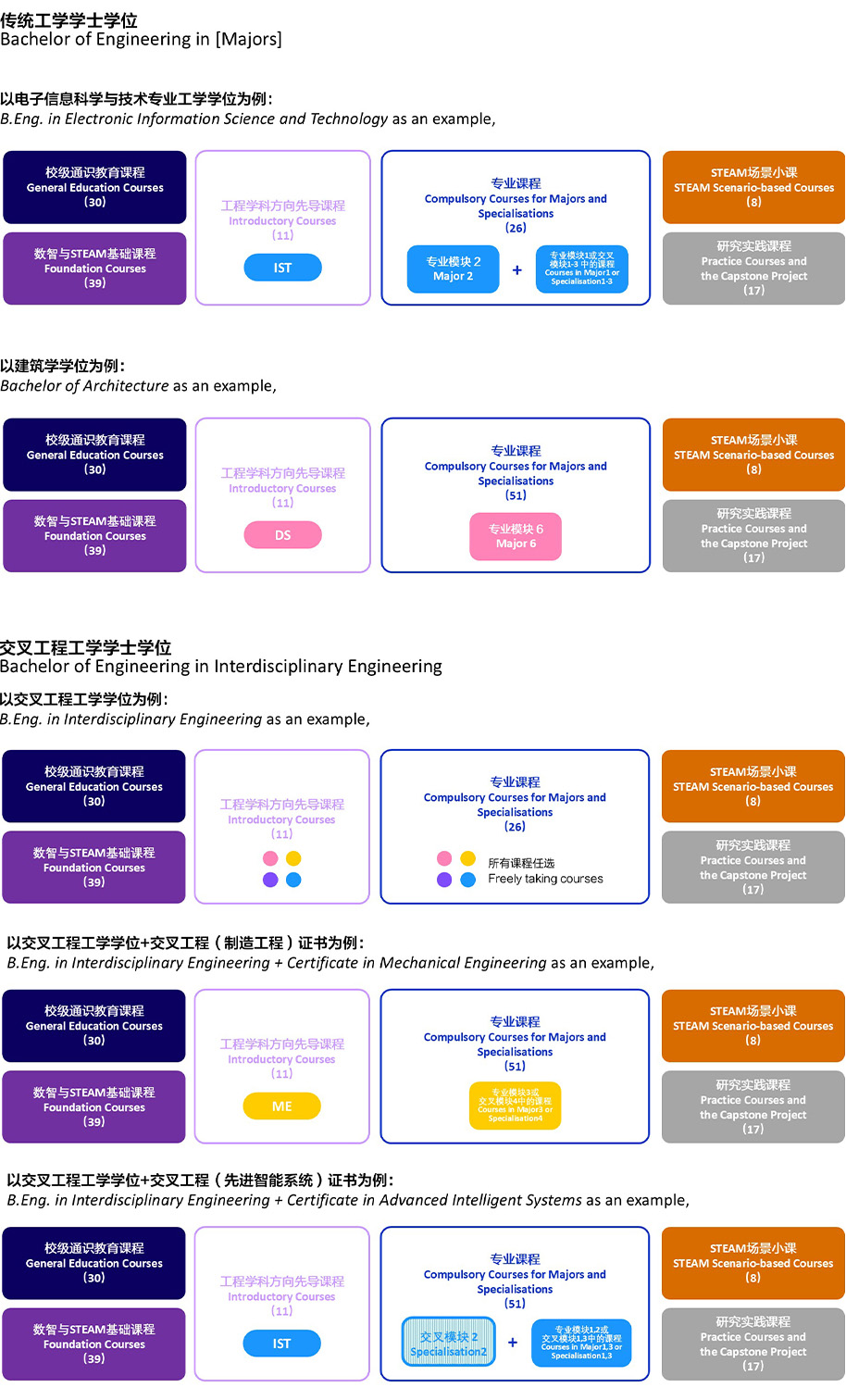
Upon meeting requirements for 1) General Education Courses, 2) Foundation Courses, 3) Introductory Courses, 5) STEAM Scenario-based Courses, and 6) Practice Courses and the Capstone Project, students will be awarded different types of degrees based on their selected courses and/or course packages from 4) Compulsory Courses for Majors and Specialisations:
Students can graduate with a traditional engineering degree in a major by completing the required course package. If the total credits in that package fall short of the minimum requirement, they must take additional courses from the same track to meet it. In addition, students are expected to fulfill all other compulsory course requirements specified by their major.
Students who fulfil the requirements of the five- year architecture program will be awarded a Bachelor of Architecture (B.Arch.) degree.
Students can also graduate with the new interdisciplinary engineering degree by freely taking a minimum required credits from Compulsory Courses.
If students further meet the following requirements, they can obtain certificates of tracks/specialisations:
Students who obtain required credits of courses all within a single track will be awarded a Certificate of the Track (e.g., Certificate in [Track Name]).
Students who complete all courses from a single package of specialisation, and take additional courses from the corresponding track to fulfill the credit requirement will be awarded a Certificate of the Specialisation (e.g., Certificate in [Specialisation Name]).